Lighthouse Keepers
John McCarthy - Keeper of the Old Light
by Brian Le Messurier: Keeper Of The Old Lundy Light. Published in Western Morning News, Monday 21 September, 1964.
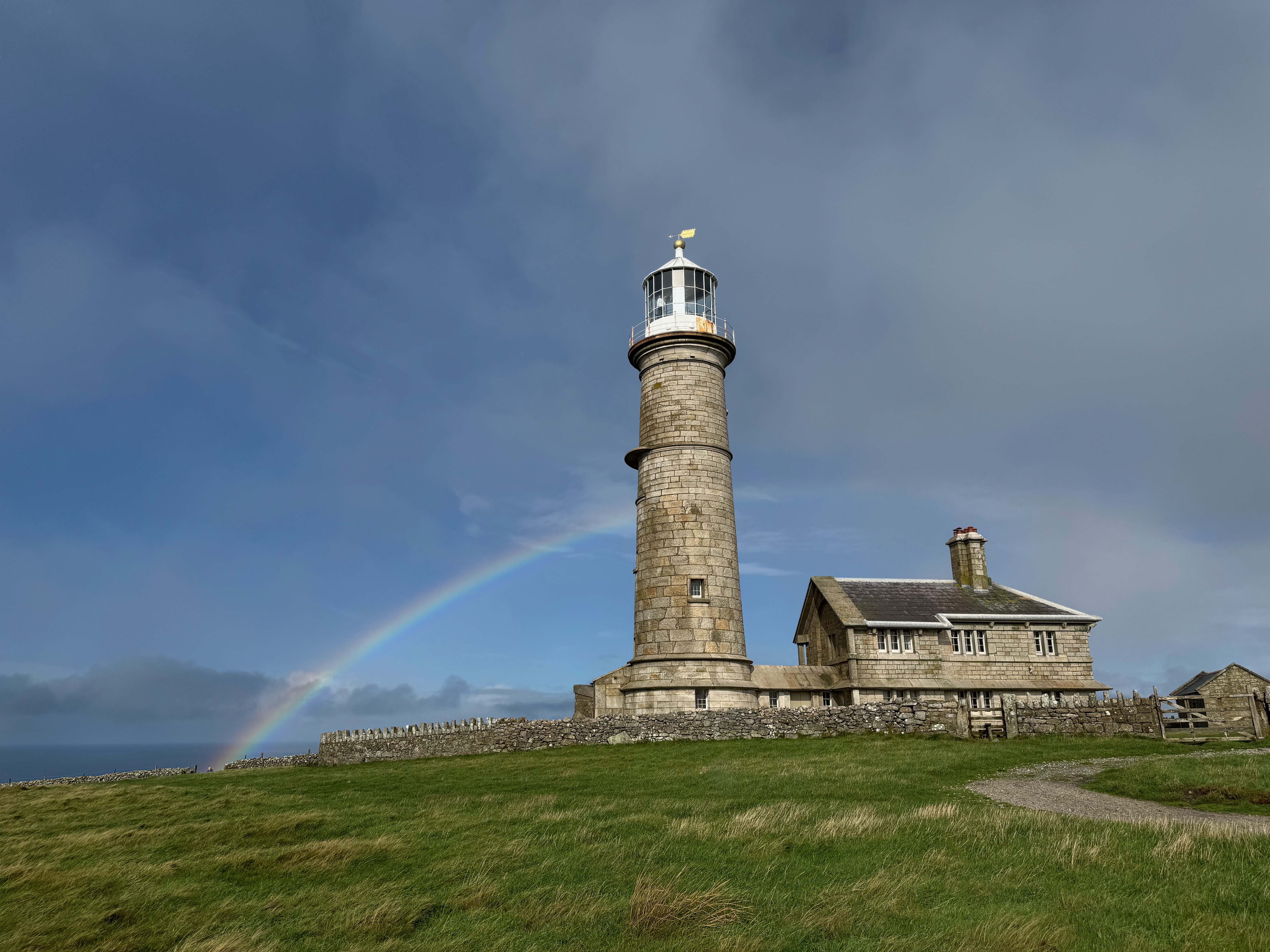
In August 1884, John McCarthy, travelled to Lundy from St. Anthony Lighthouse in Cornwall to become the principal keeper of what is now the 'Old Light'. There was still only one lighthouse, as the present stations on the north and south tips of the island were not completed until 1897. John McCarthy took with him his wife and children, as families accompanied the keepers on Lundy at that time. There were six children already, three boys and three girls (Jane, Louise and Lilian). The two eldest boys, Jack and Dan, soon left the island to make their way in the world. Another boy, Augustus George, was born to Mrs. McCarthy three months after the family arrived. The baby was born in the island farmhouse, as it had been a difficult confinement, and the mother needed to be near such medical care as was available. Even so, the child's life was despaired of, and the Rev. HG Heaven baptised him after five days. He survived but was always delicate.
The lighthouse compound, on the highest point of the island, was the home of the McCarthy family more particularly the four-roomed principal keeper's cottage. This dwelling no longer stands; it was demolished about 1895.
It was no real handicap for boys and girls to be on the island. There were several other children besides the lighthouse families, and the Squire, who taught the boys, had been a headmaster before taking up residence on Lundy. The girls were taught twice weekly by his sister, Miss Amelia Heaven, or his cousin Miss Annie Heaven. Nor was their religious education forgotten. Services were held in the Manor Farm (now the hotel) at 4 pm on Sundays until the Squire erected a small iron church with a boarded interior in 1886. The islanders christened it the 'Tin Tabernacle' (and a Bishop of Exeter called it the 'corrugated irony'), but the varnished woodwork and the rush-bottomed chairs are still remembered, as are the summer Sunday School sessions on the cliffs at a spot called 'Benjamin's Chair'. Miss Annie Heaven was in charge and permitted the boys to carve driftwood toys with their penknives during the lessons.
Life on the island was carried on under the benevolent rule of Squire Heaven whose family had bought Lundy in 1836 and at the time the McCarthys were living there, the Squire was the Rev. Hudson Grosett Heaven BA. He was a true gentleman and everybody loved him. He possessed a magnificent white beard and whiskers and each day he walked across to the lighthouse with his dogs from the Villa (now Millcombe) and usually stopped to chat to Mrs. McCarthy and the children.
At Christmas the Squire gave each child a book with a personal inscription such as "Robert Henry McCarthy Lundy -Island Xmas 1889" and is a typical Victorian boy's story, 'Quicksilver: or the boy with no skid to his wheel' The boys especially enjoyed life on the island. 'Egging' was the favourite pursuit, and this meant being lowered over the edge of the cliff on a rope. The younger children and the girls had to be content with robbing the Puffins' nests in the old rabbit burrows.
All the children had jobs to do for their mother. There were earth closets to be cleaned out, the wash-house copper to be stoked, water to be pumped from the well, chickens to be fed and sewing to be done in the evenings.
Little is known of the day-to-day routine of the lighthouse. There does exist at the South Light, however, the log book of the visiting committee of Trinity House, and this contains references to the defects in equipment and recommendations for the more efficient working of the light. It is reassuring to note that during the time that John McCarthy was in charge, the comments are mostly of the type "found all clean and in order".
On one occasion only, was anything unusual reported and that was under the date 11th May 1892, when two of the Elder Brethren of Trinity House visited the Lundy to present John McCarthy with the testimonial granted by the Royal National Lifeboat Institution "for his gallant and successful exertions in rescuing the crew of 21 persons from the wreck of the French steamer 'Tunisle' on 19th February 1892". A donation of 15 shillings each was at the same time presented to 10 others who were associated with him on that occasion.
Later in the year, the rescue party received awards from the Board of Trade. Mr George Thomas, a fisherman, who was the first to notice the plight of the stricken ship, was presented with a silver medal, and remarked that while to one in his humble station in life a cash reward would have been so useful, yet he was proud to and grateful to receive so handsome a medal. The others received £3 each. The rescue was accomplished in a blinding snowstorm and took seven hours to complete.
When the wrecked vessel was sighted, a rocket line was fired across the ship and a makeshift life-saving apparatus devised, using a coal sack to transport the crew from ship to shore. During the rescue, the children waited impatiently at home. At last, a little group of men appeared out of the snow, dead-beat and half-frozen, back to the lighthouse. The children were shocked to see their father being assisted and feared he had been injured. A moment or two later they realised the truth; a celebratory glass of rum was responsible.
At the end of 1893, the family left Lundy as Keeper McCarthy was transferred to Great Castle Head Lighthouse, Milford Haven. The Trinity House steamer 'Ready' brought the relief keeper. By the time his luggage was landed, and the outgoing gear shipped, a still north-east wind was blowing and heavy seas were breaking on the landing beach. The ship's boat was in danger of being smashed on the rocks, so a farm wagon was backed down the beach into the sea, much to the disgust of the horses, and from this improvised jetty the family slithered into the tossing boat. In a welter of spray and spindrift, the McCarthy family left the island, which had been their home for nine years . During their stay there the children rarely visited the mainland: Lilian only left Lundy once, to stay for a few days at Ilfracombe and remembers crying continually for her mother. None of them ever returned, but they always spoke of Lundy with great affection, and kept in touch with the Heaven family for many years.
Following his tour of duty at Great Castle Head, John McCarthy was transferred to Anvil Point lighthouse, Swanage and there he settled down upon his retirement. He died there in 1911, and his wife two years later.